

A concrete slab costs $6 to $12 per square foot installed in 2026, with most homeowners landing near $8 per square foot for a standard 4-inch residential pour.
That range covers materials, labor, forming, and finishing. It doesn’t cover permits, demolition of an old slab, or decorative upgrades; those get added separately below. A basic 10×10 shed pad runs $600 to $1,200. A 24×24 garage floor runs $3,500 to $9,000. A full 2,000-square-foot house foundation lands between $12,000 and $28,000, according to 2026 contractor pricing data from Angi, HomeGuide, and the National Ready Mixed Concrete Association (NRMCA).
Every section below breaks the number down further (by size, thickness, reinforcement, region, and project type) so you can hold a contractor’s bid up against real numbers instead of guessing whether it’s fair.
What Is the Average Concrete Slab Cost Per Square Foot in 2026?
The national average concrete slab cost is $8 per square foot installed in 2026, inside a broader range of $6 to $12 per square foot for standard residential work.
That average assumes a 4-inch slab, wire mesh reinforcement, a broom finish, and level, accessible ground. Move outside those assumptions and the number shifts fast. A stamped patio can triple the price. A precast pad for a shed can undercut it. The table below sorts the most common slab categories by what actually drives their cost.
| Slab Type | Cost Per Sq Ft (2026) | Typical Use |
| Basic/utility, 4-inch | $4 – $6 | Shed pad, sidewalk, small patio |
| Standard residential, 4-inch | $6 – $9 | Patio, walkway, carport |
| Driveway or garage, 5–6-inch | $8 – $13 | Vehicle loads, 4,000+ PSI mix |
| Structural foundation | $10 – $18 | House foundation, freeze-thaw regions |
| Stamped or decorative | $15 – $30 | Pool decks, front-entry patios |
| Precast slab | $5 – $15 (specialty: $30+) | Fast install, repetitive designs |
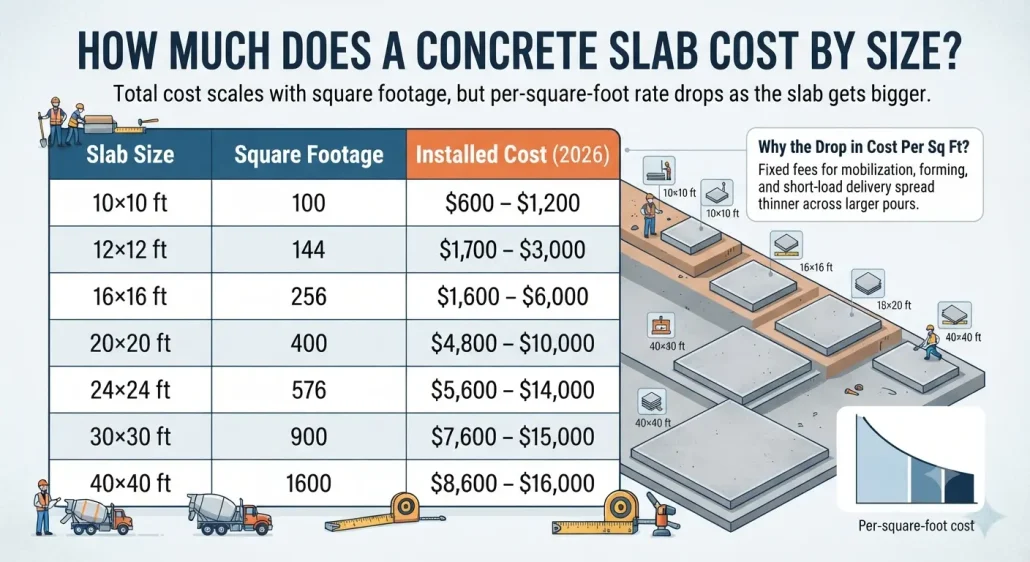
How Much Does a Concrete Slab Cost by Size?
A concrete slab’s total cost scales with square footage, but the per-square-foot rate drops as the slab gets bigger.
Mobilization, forming, and short-load delivery fees are mostly fixed, so they spread thinner across a larger pour. A 10×10 pad and a 40×40 pad don’t cost the same per square foot even at an identical spec.
| Slab Size | Square Footage | Installed Cost (2026) |
| 10×10 ft | 100 sq ft | $600 – $1,200 |
| 12×12 ft | 144 sq ft | $860 – $1,730 |
| 16×16 ft | 256 sq ft | $1,540 – $3,070 |
| 20×20 ft | 400 sq ft | $2,400 – $4,800 |
| 24×24 ft | 576 sq ft | $3,500 – $6,900 |
| 30×30 ft | 900 sq ft | $4,500 – $8,000 |
| 40×40 ft | 1,600 sq ft | $8,600 – $16,000 |
What Does Ready-Mix Concrete Cost Per Cubic Yard in 2026?
Ready-mix concrete costs $125 to $175 per cubic yard delivered in 2026, with a national average near $155.
A cubic yard is the standard unit ready-mix suppliers price by 27 cubic feet of poured concrete. Contractors convert your slab’s square footage and thickness into cubic yards to place the material order, then price the job per square foot for you.
Thickness changes the yard count fast: a 4-inch slab needs roughly 1.23 cubic yards per 100 square feet, a 5-inch slab needs about 1.54, and a 6-inch slab needs about 1.85. Going from 4 inches to 6 inches adds close to 50% more material volume on the same footprint.
Small orders carry a penalty. Suppliers charge a short-load fee on deliveries under 3 to 4 cubic yards, which can push the effective per-yard price 20% to 50% higher. If your project sits right at that threshold, it’s often cheaper to round up the order than to pay the short-load surcharge on a smaller one.
How Much of a Concrete Slab Cost Is Labor vs. Materials?
Labor accounts for 45% to 55% of a slab’s total installed cost. Materials make up the rest.
Concrete material alone (no labor) runs $1.50 to $2.50 per square foot for a standard 4-inch slab. Add reinforcement, base gravel, and forming lumber, and total materials climb to $3 to $7 per square foot. Labor covers formwork, delivery coordination, placement, screeding, floating, and finishing, and typically runs $3 to $8 per square foot. A flat, truck-accessible site with a straightforward pour sits at the low end. A sloped lot, hand-wheelbarrowed concrete, or a stamped finish pushes labor toward the top.
According to the U.S. Bureau of Labor Statistics’ 2025 OEWS release, the national mean wage for cement masons and concrete finishers is $28.87 per hour, which is the baseline driving most of that labor line item.
How Does Slab Thickness Affect Concrete Cost?
Each additional inch of slab thickness adds $0.50 to $1.25 per square foot.
A 4-inch slab is the standard for patios, walkways, and light-duty shed floors. A 5- to 6-inch slab is required for driveways, garage floors, and structural foundations, where vehicle and building loads demand more mass. Moving from 4 to 6 inches on the same footprint increases concrete volume by roughly 50%, and that volume increase is what drives the higher price per square foot on thicker pours.
How Much Does Reinforcement Add to Concrete Slab Cost?
Reinforcement is steel embedded in the slab to control cracking and carry tensile load that concrete can’t handle on its own. Two types dominate residential work.
- Welded wire mesh: $0.50 to $0.80 per square foot. Standard baseline reinforcement for patios, walkways, and light-duty pads.
- Rebar grid (#3–#4 bar): $1 to $3 per square foot. Used for driveways, garages, and foundations carrying heavier loads or sitting on expansive soil.
PSI, or pounds per square inch, measures a cured concrete mix’s compressive strength. The residential baseline is 3,000 PSI. Upgrading strength costs $10 to $40 per cubic yard above that baseline, since higher PSI requires denser mix design and more Portland cement per yard.
According to the American Concrete Institute (ACI), freeze-thaw climates in the Midwest, Northeast, and Mountain West require a minimum 4,000 PSI mix with 3% to 6% air entrainment to survive repeated freeze-thaw cycling without spalling.
How Does Region Affect Concrete Slab Cost in 2026?
Region is the single largest cost variable outside of slab specification — identical scopes run 35% to 40%+ apart across U.S. markets.
Coastal states like California and New York average close to $8.50 per square foot for a standard slab. Central states average closer to $5.35 per square foot for the same work. In dollar terms, a 400-square-foot patio that costs $2,800 in Tennessee can cost $4,200 to $5,600 for the identical specification in California.
| Region | Typical Cost Per Sq Ft | Ready-Mix $/Yd³ |
| Central / Midwest / South | $5.35 – $7.50 | $110 – $165 |
| National average | $8.00 | $125 – $175 |
| Coastal (CA, NY, Pacific NW) | $8.50 – $18.00 | $150 – $250 |
How Do You Calculate Your Own Concrete Slab Cost?
Multiply your slab’s square footage by a per-square-foot rate between $6 and $12 to get an installed cost range.
Start with length times width to get square footage. Match that number to your project type ($6–$9 for a standard patio, $8–$13 for a driveway or garage) and multiply both ends of the range. A 22×18 driveway pad (396 square feet) at $8–$13 per square foot lands between $3,168 and $5,148 before add-ons like a permit or old-slab removal.
For material-only budgeting, convert square footage into cubic yards instead. A 4-inch slab needs about 1.23 cubic yards per 100 square feet, so that same 396-square-foot driveway needs roughly 4.9 cubic yards. At $125–$175 per cubic yard delivered, raw material runs $610 to $860, and since that sits above the 3-to-4-yard short-load threshold, it avoids the surcharge that smaller orders pay. Add labor, reinforcement, and base prep on top of the material figure to reach the full installed number.
What Do Sub-Base, Control Joints, and Screed Mean on a Concrete Bid?
A handful of terms show up on nearly every concrete quote. Knowing them turns a confusing bid into a checklist you can verify.
- Sub-base: the compacted gravel layer under the slab, usually 4 to 6 inches deep, that provides drainage and prevents settling.
- Control joints: planned grooves cut into the slab, typically every 8 to 12 feet, that direct cracking to a straight line instead of a random split.
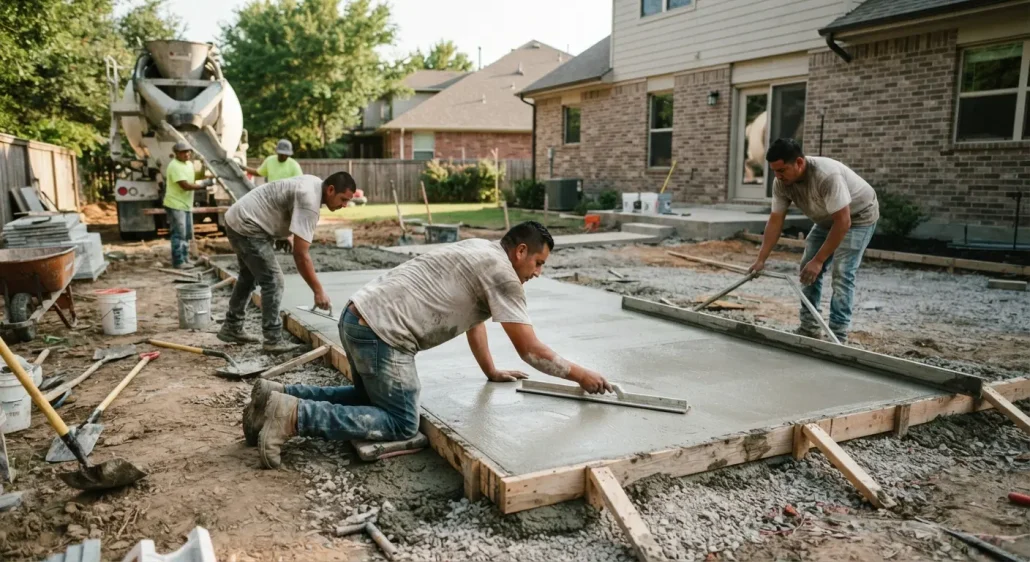
- Screed: a straight board or tool dragged across wet concrete to level it flush with the forms.
- Float and trowel: hand or power tools that smooth the surface after screeding. For instance, a bull floats first, then a hand or power trowel for the final finish.
- Curing: the multi-week hydration process after finishing, during which the slab must stay moist to reach its rated PSI strength.
How Have Concrete Slab Costs Changed Since 2025?
Labor costs for concrete work are rising 3% to 5% annually in 2026, while material prices have stabilized after 2025 volatility.
The U.S. imports roughly 20% of the cement it uses, which makes ready-mix pricing sensitive to trade policy and import costs. That pressure showed up in 2025 price swings; by 2026, ready-mix pricing settled into the current $125–$175 per cubic yard band. Labor hasn’t stabilized the same way. Cement mason wages continue climbing faster than general inflation, which is why the labor share of a slab’s total cost (45% to 55%) keeps edging upward year over year rather than staying flat.
What’s Included (and Excluded) in a Concrete Slab Quote?
A legitimate concrete bid specifies eight things in writing: slab dimensions, thickness, PSI, reinforcement type and spacing, sub-base depth, finish type, control joint plan, and curing method.
A bid missing any of those isn’t comparable to one that has them, even if the total dollar figure looks similar. Beyond scope, several common add-ons sit outside the base price and catch first-time buyers off guard:
- Permits: $50 to $500, depending on jurisdiction and project type.
- Vapor barrier: $0.10 to $0.25 per square foot, essential under basements or any indoor flooring.
- Old slab demolition: $2 to $6 per square foot to break out and haul away existing concrete.
- Control joint sawing: $0.10 to $0.25 per linear foot, typically spaced every 8 to 12 feet.
- Excavation or grading: Priced separately if the site isn’t already level and compacted.
Concrete Slab Cost by Project Type
Slab pricing shifts by end use because each application carries different thickness, reinforcement, and finish requirements.
| Project Type | Cost Per Sq Ft | Typical Total |
| Shed pad | $4 – $8 | $600 – $1,500 |
| Patio (broom finish) | $6 – $9 | $2,400 – $4,800 (400 sq ft) |
| Sidewalk | $5 – $8 | Varies by length |
| Driveway | $8 – $20 | ~$6,400 (640 sq ft avg) |
| Garage floor (2-car) | $8 – $13 | $5,000 – $7,500 |
| House foundation | $5 – $14 | $12,000 – $28,000 (2,000 sq ft) |
| Basement floor | $6 – $12 | Add $0.10–$0.25/sq ft for vapor barrier |
Concrete Slab vs. Crawl Space vs. Basement: Which Foundation Costs Less?
A concrete slab foundation costs $5 to $14 per square foot, making it the cheapest of the three main residential foundation types. A basement runs $35 to $50 per square foot before interior finishing.
A crawl space foundation sits in between, typically $8 to $20 per square foot, since it needs perimeter footings and elevated framing rather than a single poured surface. According to U.S. Census Bureau New Residential Construction data, roughly 75% of new U.S. homes use slab foundations, largely because of that cost gap and because slabs skip the excavation a basement requires.
| Foundation Type | Cost Per Sq Ft | Best Climate Fit |
| Slab-on-grade | $5 – $14 | Warm, flat, well-drained soil |
| Crawl space | $8 – $20 | Moderate climates, uneven sites |
| Full basement | $35 – $50+ | Cold climates, sloped lots |
Is DIY Cheaper Than Hiring a Concrete Contractor?
DIY concrete work saves 40% to 60% on material cost alone, but it shifts all installation risk onto you.
A 10×10 slab runs $500 to $600 in DIY materials (concrete, gravel base, forms, and reinforcement) against $600 to $1,200 hired out. Scale that up: a 20×20 slab costs $1,200 to $1,600 in DIY materials versus $2,400 to $4,800 installed by a contractor. Tool rental adds $200 to $400 on top of DIY material costs, for a mixer, screed, and float.
The savings are real, but finishing skill is what actually determines whether a slab lasts. Poor screeding and rushed curing are the leading causes of cracked slabs. If you can’t finish the full pour within the working time of the mix, roughly 60 to 90 minutes in warm weather, hiring out is usually the cheaper decision once you count a redo.
How Can You Lower Concrete Slab Cost Without Cutting Corners?
- Get at least three itemized quotes written to the identical scope, so you’re comparing the same slab, not just a total number.
- Combine multiple concrete projects with one contractor to spread mobilization costs across more square footage.
- Schedule the pour in the off-season. That’s because fall and winter demand is lower in most regions, and bids can run 5% to 15% below peak spring and summer pricing.
- Choose precast components over on-site pours for repetitive shapes, like sidewalk squares or utility pads.
- Skip decorative stamping or staining if the slab is purely functional; a broom finish costs a fraction of the price.
How Do You Read a Concrete Slab Bid Like an Estimator?
A bid is only as useful as its detail. Two contractors quoting the exact same total dollar figure can be pricing completely different slabs if one skips PSI, reinforcement spacing, or sub-base depth.
Run every bid through the same checklist: does it name the thickness, the PSI rating, the reinforcement type and spacing, the sub-base depth, the finish, the control joint layout, and a list of what’s excluded? If a bid is just a single total with no line items, ask for a written scope before signing. A contractor who can’t produce one usually can’t manage the change orders that follow either
A few red flags are worth watching for regardless of price. A bid significantly below $5.50 per square foot in an average-cost market usually means someone is cutting sub-base depth, reinforcement, or curing time. A bid above $13 per square foot outside a high-cost coastal metro deserves a second and third quote before you sign. Price alone doesn’t tell you which contractor is right; matching scope does.
Frequently Asked Questions
What is the cheapest way to pour a concrete slab?
Precast slabs and off-season DIY pours are the cheapest options, typically 40% to 60% below a standard contractor-installed slab. Skipping decorative finishes and combining projects with one contractor also reduces cost without lowering slab quality.
How much does a 12×12 concrete slab cost?
A 12×12 concrete slab (144 square feet) costs $860 to $1,730 installed in 2026, based on the standard $6–$12 per square foot range for a 4-inch residential pour.
Is 4 inches of concrete enough for a shed?
Yes, 4 inches of concrete is enough for most sheds. It’s the standard thickness for light-duty structures without vehicle traffic. Sheds storing heavy equipment or intended for future garage conversion should use 5 to 6 inches with reinforcement instead.
How long does a concrete slab take to cure before use?
A concrete slab cures enough for light foot traffic in 24 to 48 hours and reaches full structural strength in about 28 days. Vehicle traffic should wait at least 7 days, longer in cold or humid conditions.
Do I need a permit to pour a concrete slab?
Most jurisdictions require a permit for structural slabs like foundations, garages, and driveways, typically costing $50 to $500. Small non-structural pads, like a 10×10 shed base, are often exempt.
What’s the difference between cost per cubic yard and cost per square foot?
Cost per cubic yard ($125–$175 in 2026) reflects material only. Cost per square foot ($6–$12) includes material, labor, equipment, and finishing. Use per-square-foot figures for full project budgeting, and per-yard figures only when pricing raw material orders.
Does a concrete slab add value to a home?
Yes. A well-built concrete slab, especially a driveway or patio, typically recoups 50% to 70% of its cost in added home value. Structural foundation slabs don’t add resale value directly but are required for the home to exist at all, so their cost is baked into overall build value rather than tracked as a standalone upgrade.
Can you pour a concrete slab in cold weather?
Yes, but cold-weather pours cost more and require extra steps. Concrete needs to stay above roughly 50°F to cure properly, so winter pours often add insulated blankets or heated enclosures, which raises labor cost. Most contractors avoid pouring below freezing without those protections, since ice crystals forming in the mix weaken the final slab.
The Bottom Line
A concrete slab costs $6 to $12 per square foot installed in 2026, and the exact number inside that range comes down to thickness, reinforcement, region, and what’s written into the bid. Use the tables above to sanity-check any quote you receive, and don’t sign anything that doesn’t spell out PSI, reinforcement, and finish in writing. If you do not want the hassle of calculating slab and other construction elements cost yourself, call Construction Estimator team and get a free quote for your next project in just a few minutes.